Showing posts with label chess movie. Show all posts

Wednesday, June 08, 2011


DEATHNOTE 2 (THE LAST NAME)

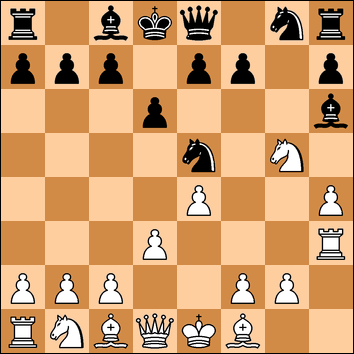
I just watched Deathnote 2 again, because I was not satisfied with the chess position where L was playing alone while waiting for his death. And sure enough, I found that the position was not in the liking of any good chess player.


From the position, L moved the Black Knight to f6, then the White pawn to d4. It was also hard to determined whether the Black King had already moved or just plain misplaced.

I am really against the film makers who do not consult any chess players when setting up the board and expect us to believe that the character is truly a genius!
Thursday, August 06, 2009

REAL CHESS IN MOVIES

I totally agree when Mr. Jeremy Silman said that 'movies and TV shows make a joke of real chess positions and real chess lingo.' (1) Sparring those chess movies which really portray chess as the main theme or plot, those scenes where the characters played chess just to show that they are geniuses, are filled with fake chess positions and unthinkable chess situations (2) - the boards were not correctly set; the pieces were put in impossible positions; and (the one which I hated the most) the supposedly winners said 'checkmate!' when hardly anybody said that in real life chess games!

I do not want to write about all the chess movies or chess scenes which I have seen or yet to watch, you can read about it in an excellent article at Chessville (3) or watch the pictures at Chess in the Cinema (4), but I want to share here real chess positions from the movies which can actually be set up when chess masters are consulted whenever a chess movie or a chess scene is to be made. Three chess scenes fascinate me because of their authenticity, and I tried my best to pause the movie in order to recreate the positions on my chess board:

1. Harry Potter and the Sorcerer's Stone

This position was created by Jeremy Silman, but it was cut by the director for the sake of character developments and therefore lost its chess value. (5)

2. The Luzhin Defense


The credits for the chess scenes goes to GM Jonathan Speelman. This final game between Luzhin and Turatti captured the chess audience completely. (6)

3. The Innocent Moves (Searching for Bobby Fischer)


This is the final game between Waitzkin vs Poe. The position was contrived by Josh Waitzkin himself with the help of Bruce Pandolfini specifically for the film. (7)


Monday, October 13, 2008

CHESS IN MOVIES

I have two chess movies on my CD rack, The Luzhin Defence and Innocent Moves (or sometimes called Searching for Bobby Fischer). However, there are many chess movies made which I love to get a hold on. Some of the movies in the list here are taken from Movies and Chess website:

  • Chess Fever (1925) was a hilarious old Russian short film. A bride nearly gets mad because her betrothed (played by the russian comidian Pudovkin) has more interest in chess than in her (and everybody around her likewise). The grandmaster tournament Moscow 1925 plays an important part in the plot. The world champion in this movie is played by J.R.Capablanca.
  • The Seventh Seal (1957). A Knight and his squire are home from the crusades. Black Death is sweeping their country. As they approach home, Death appears to the knight and tells him it is his time. The knight challenges Death to a chess game for his life. The Knight and Death play as the cultural turmoil envelopes the people around them as they try, in different ways, to deal with the upheaval the plague has caused.
  • Return From the Ashes (1965) Stanislaus Pilgrin, a Polish chess master and handsome gigolo, marries wealthy Jewish widow, Dr. Michele Wolf, an X-ray technician and has an affair with her step-daughter, Fabienne and then plots to murder them both in a scheme that will have him inherit their money.
  • Night Moves, a 1975 Classic Detective movie not to be confused with the more recent Knight Moves, this movie featured Melanie Griffith and Gene Hackman as a detective who uses the famous game where the GM missed the sacrifice of his queen to mate with three little "Knight moves" to illustrate how he feels he is overlooking something important to solve a murder.
  • The Great Chess Movie (1982) with an interview with Igor Ivanov. Chess and the best players of the game are the focus of this video which examines and analyzes players such as Anatoly Karpov, Viktor Korchnoi and Bobby Fischer.
  • Dangerous Moves (Oscar for Best Foreign Film in 1985) Two very different men compete in the World Chess Championship Games. One is a 52-year-old Soviet Jew and chess master for the past 12-years, and the other is a 35-year-old genius who defected to the West several years earlier.
  • Born American (1986) It was really a very bad movie, 3 young Americans decide to test the security on the Finnish-Soviet border, get caught and thrown in a gulag, in the gulag they find that the prisoner society is run by chess games, with human pieces, that decide who is the strongest.
  • Knight Moves (1992) A chess grandmaster is in a big tournament, and when his lover is found painted up and the blood drained out of her body he becomes a chief suspect. After he gets a call from the killer urging him to try and figure out the game, he cooperates with police and a psychologist to try and catch the killer, but doubts linger about the grandmaster's innocence as the string of grisly murders continues.
  • Searching For Bobby Fischer or Innocent Moves (1993) Notice in the scene where Josh is playing the guy at the Manhatten Chess Club (the Gummy Bear guy) and notice what colour he has when the game begins. Then notice what colour the guy is playing when he tips over his king and resigns. It is a very good movie about a father and son relationship in which chess takes an important part. But it's not a film "about chess".
  • Fresh (1994) Michael (or Fresh as he's well known) is a 12-year-old drug pusher who lives in a crowded house with his cousins and aunt. His father has become a street bum,but still meets with fresh on occasion to play chess. Fresh is rather quiet in a crazy world. Fresh' sister is a junkie who sleeps with the dealers that fresh sells for. As the story progresses Fresh realizes that he doesn't want to sell drugs anymore, he wants revenge.
  • Long Live the Queen (1996) A Dutch childrens' movie, Esme Lammers. Tiba Tossijn stars as a bright but misunderstood schoolgirl who escapes unhappiness when, in her imagination, chess pieces come alive and the White Queen (vivacious Moniqe van de Ven) advises her both on the best moves to make on the chess board and in life itself.
  • The Luzhin Defence (2000) Set in the late 1920s, The Luzhin Defence tells the story of a shambling, unworldly chess Grand Master who arrives in the Italian Lakes to play the match of his life and unexpectedly finds the love of his life. Discovering his prodigious talent in boyhood overshadowed by his parents' failing marriage, Luzhin's lyrical passion for chess has become his refuge and rendered the real world a phantom. Already matched up by her family to the very suitable Comte de Stassard, when Natalia meets Luzhin, she is drawn to the erratic genius and offers him a glimpse outside of his chess obsession. But it is a world he is not equipped to deal with and his two worlds collide to tragic effect.
  • Game Over: Kasparov and the Machine (2004) Campbell and Hsuing-Tsu had worked side by side with master chess player Joel Benjamin to create a machine that could compete with the top human chess experts, and while Kasparov easily bested Deep Blue in their first tournament, it was a different story a year when he returned for a rematch. In the second game of the series, Kasparov was so roundly defeated that the champion began suggesting IBM was the computer as a decoy for a human player, and what started as a friendly exercise between Deep Blue's designers and the champion became an increasingly ugly battle of egos with many viewing the event as a publicity stunt used to prop up IMB's sagging public image.
  • Schwarz und Weiss wie Tag und Nacht which is in German and has English subtitles. It's a little corny, a computer genius programs computer to play chess, it loses badly to the World Champion who makes fun of the programmers effort, so the genius learns to play at the top level himself with the idea of getting even.

Monday, July 07, 2008

CHESS LEARNING AGE

When is the right time to start learning chess? In my case, I learned chess when I was fifteen. I just finished my PMR exams and there was nothing to do except attending some post-PMR programmes organized by the school which was made compulsory for PMR students. I, however, went to the AV room and found several of my friends were playing chess. I learned the moves and no more than a year later I had beaten every one of them. So, is learning at an earlier age gives an advantage over late learners, or is it the other way around? The famous story of the Polgar sisters, who were trained by their father when they were merely 4 years olds, seems to stress the point. Nevertheless, a blogger by the name of Half Sigma does not agree and wrote an article refuting the works of Laszlo Polgar. In contrast, there's another father who initially did not make his child play chess, rather the child himself was a natural prodigy. Fred Waitzkin, and his chess prodigy Josh (picture right), were potrayed in a film The Innocent Moves (Searching for Bobby Fischer).


LinkWithin

Related Posts with Thumbnails